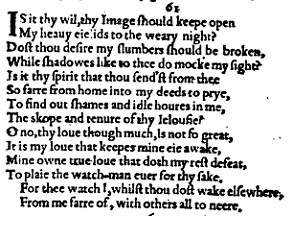
IS it thy wil, thy Image ſhould keepe open
My heauy eielids to the weary night?
Doſt thou deſire my ſlumbers ſhould be broken,
While ſhadowes like to thee do mocke my ſight?
Is it thy ſpirit that thou ſend’ſt from thee
So farre from home into my deeds to prye,
To find out ſhames and idle houres in me,
The skope and tenure of thy Ielouſie? O no,
thy loue though much, is not ſo great,
It is my loue that keepes mine eie awake,
Mine owne true loue that doth my reſt defeat,
To plaie the watch-man euer for thy ſake.
For thee watch I, whilſt thou doſt wake elſewhere,
From me farre of, with others all to neere.
Sonnet 61 shares its theme and vocabulary with Sonnets 27, 28 and 43, in which the poet is also deprived of sleep. 1 It opens by asking if it is the friend’s intent (“wil”) that his image should keep open the poet’s “heauy eielids” as he seeks sleep. By transference the night is “weary” or brings weariness. Is it his desire that the poet’s sleep should be disturbed (“broken”) as spectres (“shadows”) bearing his likeness taunt the poet’s sight (“mocke my sight”)?
Has the friend, while far from home, sent forth his “spirit” to spy on the poet’s actions (“prye;” compare Isaiah’s question, “watchman what hast thou espied by nyght?” (21.11; BB) and try to uncover his “shames and idle houres,” actions that bring shame and wasted times that yield no return. Is that the “skope and tenure” of the youth’s “Ielousie”? ‘Scope and tenor’ (“tenure” being its variant spelling) was a common duplicative phrase of legal origin (both words mean the same), intending the substance or purpose of an argument or the like (compare William Perkins who, writing of God’s promises, cautions, “we must know the scope and tenour of them, that we be not deceiued.” 2 The friend’s jealousy is either his suspiciousness or his solicitous watching over the poet.
The poet’s response to the questions is negative, “O no.” The youth’s love, though strong (“much”), is not strong enough (“great”). It is the poet’s love for him that keeps the poet “awake” and stops his sleep (“doth my rest defeat”), so that he can “plaie the watch-man euer for thy sake.” A ‘watchman’ stayed awake at night, while keeping guard, a role the poet will play always (“euer”) for the youth’s sake.
He exclaims, “For thee watch I,” where “watch” intends ‘remain awake because of you,’ or ‘look out for you,’ or ‘keep a vigil for you as might a servant.’ On the other hand the youth “dost wake elsewhere,” either ‘wakes up elsewhere,’ or ‘keeps a wake or vigil elsewhere,’ or even ‘stays up at night to revel elsewhere.’ He remains remote from the poet (“From me farre of”), and, in a suspicious and worried epithet, all too close to other wakers (“with others all to neere”).
61.1. Compare “weary night” (61.2), “Weary with toyle” (27.1); “So farre from home” (61.6), “from far” (27.5), “How far . . farther off from thee” (28.8); “heauy eyelids” (61.2), “drooping eye-lids” (27.7), “heauy sleepe” (43.12); “shadowes like to thee” (61.4), “their shaddoe” (27.10), “whose shadow shaddowes doth make bright” (43.5), “thy shadowes forme” (43.6), “thy shade . . imperfect shade” (43.8/11); “rest defeat” (61.11), “benifit of rest” (28.2).
61.2. William Perkins, A Commentarie or Exposition, vpon the fiue first Chapters of the Epistle to the Galatians (Cambridge: John Legatt, 1604) 178, “First, we must haue knowledge of the maine and principall promise, touching the blessing of God in Christ, and of all other promises depending on the principall: and we must know the scope and tenour of them, that we be not deceiued.” SInne of ſelfe-loue poſſeſſeth al mine eie, And all my ſoule, and al my euery part; And for this ſinne there is no remedie, It is ſo grounded inward in my heart. Me thinkes no face ſo gratious is as mine, No ſhape ſo true, no truth of ſuch account, And for my ſelfe mine owne worth do define, As I all other in all worths ſurmount. But when my glaſſe ſhewes me my ſelfe indeed Beated and chopt with tand antiquitie, Mine owne ſelfe loue quite contrary I read Selfe, ſo ſelfe louing were iniquity, T’is thee (my ſelfe) that for my ſelfe I praiſe, Painting my age with beauty of thy daies, The “Sinne of selfe-loue,” with whose nature Sonnet 62 opens and which possesses the poet’s every part, was a sin of frequent censure and the root of much else. Thomas Wright gives a typical analysis in The Passions of the minde of 1604: Selfe-love then may bee defined, an inordinate inclination of the soule, affecting too much the pleasures of the body against the prescript of right reason: this may well be called N48″LJ\”, olde Adam, the law of the flesh, sensualitie, the enemie of God, the spring of vice, the roote of impietie, the bane of godly conversation, the obiect of mortification, the sincke of sinne, ever craving, never content tyrannizing over the greatest, and overthrowing the least. 1 Self-love was also a mortal sin. William Perkins, the popularist Cambridge Calvinist, illustrates its nature in detail: “this must be held and remembred for a Ground, That euery sinne, in what degree so euer it is, is mortall of it selfe: and no sinne is veniall in it owne nature” 2 Such sin infects every part of the soul and body: Perkins in his Catechism describes it, Q. In what part of man is it? A. In euery part both of body & soule, like as a leprosie that runneth from the crowne of the head to the sole of the foote. Q. Shew me how euery part of man is corrupted with sinne? A. First in the mind there is nothing but ignorance and blindnesse . . . the members of the body are the instruments and tools of the mind for the execution of sinne. 3 In Sonnet 62, likewise, the sin possesses all the poet’s “soule” and his “euery part.” For a sin of such “degree” no “remedie” is possible, since it is so firmly “grounded” in his heart, the proper technical term for sin’s indwelling (see Perkins above). Philautia, manifest firstly in the poet’s “eie,” as it was in its archetype, Narcissus, was a favourite of emblem books. Shakespeare has drawn on Whitney’s emblem, “Amor sui,” whose device is an exact copy of Alciato’s pictura for “Philautia,” which featured Narcissus gazing at his face in the water. 4 More particularly the sonnet reflects the marginalia text: “Ovid.Metam.lib.3,” which contains Narcissus’ exclamation, ‘I burn with love of myself’ (“uror amore mei”), 5 and “Anulus in pict. to Whitney’s poës.,” a reference to Bartolomaeus Anulus (Barthélemy Aneau), whose book of emblems, Picta Poesis. Vt Pictvra Poesis Erit (‘Poetry Painted. As a Painting so Poetry will be’), was published in Lyon in 1552. Its echo of Horace (“Ut pictura poesis,” or ‘poetry is as a picture’) accounts for Sonnet 62’s final “Painting” non-sequitur. 6 The poet, gazing upon himself, deceives himself: he thinks “no face so gratious is as mine.” Like Narcissus, who in Whitney’s words “loude, and liked so his shape,” so the poet reflects, “No shape so true [as mine],” where “true” means straight or properly proportioned. He considers it of highest value (“of such account”) and for his own sake adjudges (“define”) his worth to surpass that of all others in every respect (“I in all other in all worths surmount”). Such distorted judgements are typical of self-love: Whitney cautions that it “makes vs iudge too well of our desertes” and appends Terence’s adage in Andria, “omnes sibi malle melius, quam alteri” (‘every man prefers his own worth to another’s’). 7 A further result of self-love possessing all the eye is a “blindness most extreme” in Whitney’s words; in Narcissus’ case it “doth . . blinde his eyes.” 8 The sestet changes the focus of the poet’s gazing. When his reflection (“glasse”) shows his actual self (“my selfe indeede”), it is a self that is “Beated,” either ‘weather-beaten’ or ‘beaten’ by age as a fell is in tanning. It is a self that is “chopt with tand antiquity;” “chopt” means ‘struck’ as in the tanning process or ‘cracked’ and ‘chapped’ by age which renders the skin leathery; “tand” is ‘browned’ or ‘made leathery’ by the effects of age. When the poet truly looks on such a self, he interprets (“read”) his self-love quite differently (“contrary”): to love such a battered self would constitute a sin (“iniquity”). He asserts finally that he is in fact praising the youth, who is his other self (“my selfe”), to his own advantage (“for my selfe”), by depicting (“Painting”) his aged state in words celebrating the youth’s beauty: the “ut pictura poesis” motif allows him to claim that, as with painting, his verses depict or cover over cosmetically his age through lines which give praise to the youth. _________________________ 62.1. Thomas Wright, The Passions of the minde in generall (London: Valentine Sims [for Thomas Thorpe], 1604) 14-15. 62.2 William Perkins, The First Part of The Cases of Conscience, Wherein specially, three maine Questions concerning Man, simply considered in himselfe, are propounded and resolued (Cambridge: John Legatt, 1604) 33. 62.3. William Perkins, The Foundation of Christian Religion: Gathered into Sixe Principles (London: John Porter, 1597) 7. 62.4. Whitney 149; Andrea Alciato, Emblemata (Lugdunii: Mathias Bonhomme, 1550) 77. 62.5. Ovid, Met. 3.464; cf. Golding 3.533, “he is enamoured of himselfe.” 62.6. Whitney cites two lines from Aneau’s Emblem, M37!KI3! (Philautia = love of self), “Narcissus liquidis formam speculatus in undis, Contemnens alios, arsit amore sui &c.” (Narcissus, having looked at himself in the limpid waters, spurning others, burnt with love of self etc.’). Cf. Bartolomaeus Anulus, Picta Poesis. Vt Pictvra Poesis Erit, (Lugdunii: Mathias Bonhomme, 1552) 51. Aneau uses only an approximation of Alciato’s pictura for his emblem on self-love and reserves it for another more explicit emblem entlitled, “Libido effoeminans.” Cf. Horace, Ars Poetica 361. 62.7. Terence, Andria 427; Whitney’s final marginal entry, Cicero, Tusculanae Disputationes 5.21.63, makes the same point: ‘Everything is beautiful to itself. I have as yet known no poet, who did not think himself the best. Things are like that: my things delight me, your things delight you’ (“Suum cuique pulchrum est; adhuc neminem cognoui poëtam, qui sibi non optimus videretur; sic res habet, me delectant mea, te tua”). 62.8. Golding 3.542.